
Higher Occupational Certificate: Motion Graphics Designer
Turn ideas, information and brand messages into clear moving visuals. You will learn to read a brief, research an audience, plan a motion project and produce animation-led content for film, television, advertising, social media and digital platforms.
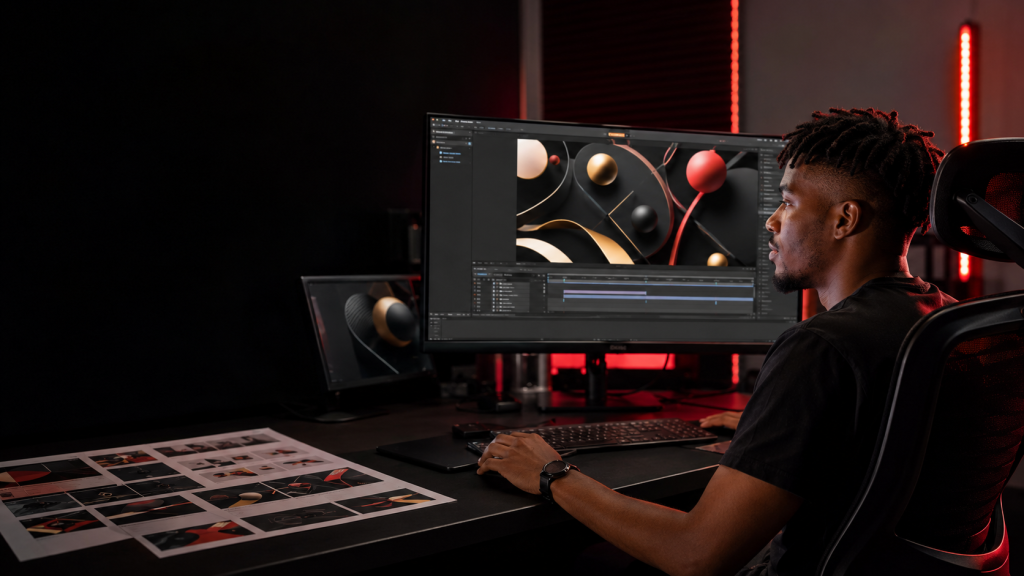
Learn the full process.
Motion graphics sits where design, animation, video and communication meet. This qualification takes learners through the full process: understanding the audience, interpreting the brief, developing a visual direction, preparing assets, animating the work and refining it for the platform on which it will be seen.
Alongside creative and technical work, learners cover project organisation, client communication, intellectual property, budgets and basic business administration. The aim is to leave with both a portfolio and a practical understanding of how motion work moves from brief to delivery.
Skills you can use.
- Analyse a client brief and identify the intended audience and user experience.
- Develop concepts, sketches, narratives, storyboards and style frames.
- Prepare visual, photographic and video assets for animation.
- Create, test and refine motion graphics for different screens and platforms.
- Complete post-production and prepare final work for delivery.
- Manage projects, documentation, copyright, budgets and client communication.
Knowledge. Practice. Workplace experience.
Choose face-to-face study in Johannesburg or Pretoria, or complete the learning component online. The programme combines guided knowledge sessions, practical work and workplace experience.
Online study does not remove the practical, workplace or external-assessment requirements. Admissions will confirm where practical activities, workplace evidence and the EISA must be completed for your intake.
Knowledge modules · 115 credits
- Basic elements and principles of design
- Principles of visual content development
- Photography and videography for visual content developers
- Design technology used by visual content developers
- Business communication and administration
- Processes of motion graphics development
Practical skill modules · 70 credits
- Assess the target market and audience preferences
- Conduct motion graphics pre-production
- Create and produce motion graphics
- Perform business supervision and administration functions
Work experience modules · 44 credits
- Audience and client requirement processes
- Motion graphics pre-production processes
- Creation and production in a workplace setting
- Business administration support
How progress is assessed.
Assessment combines knowledge work, practical projects and a verified workplace portfolio. Learners must complete all knowledge, practical and work experience modules before entering the External Integrated Summative Assessment.
The EISA includes written assessment and a portfolio of evidence drawn from workplace outcomes. The Assessment Quality Partner is MICT SETA.
Take the course information with you.
Course prospectus
Fee structure
Check that you qualify.
An NQF Level 4 qualification is required. Recognition of Prior Learning may be used for access or module exemption where the approved RPL requirements are met.
Applicants should be comfortable working on a computer and should expect regular design practice, visual research and project work.
Apply online and select your preferred study format. Submit your identity document and proof of the required prior qualification. Admissions will confirm the intake, timetable, practical and workplace arrangements, and any additional documents. If you already have design, animation or video work, include a small portfolio link; it helps admissions understand your current level, but it is not a substitute for the formal entry requirement.